
The Future of Learning is Peer-to-Peer: How Enterprise Thought Leadership is Transforming Corporate L&D
The Learning & Development (L&D) function of organizations is evolving. At first sight, this statement might come across as unsurprising and in fact, a natural corollary of everything else shifting in business and society over the past decades. However, corporate L&D is undergoing a profound transformation that is arguably independent of any of the tectonic shifts we are seeing in business – those driven by technology & digitalization, supply chain transformations or new working models (i.e., remote working / WFH).
Exhibit 1 below calls out some of the key shifts we are seeing in corporate L&D and their key driving forces or enablers
Exhibit 1: Shifting corporate Learning & Development (L&D) landscape
| Dimension | Traditional L&D | Evolving L&D | Nature of Shift | Driven By |
|---|---|---|---|---|
| Time & Flexibility | Scheduled sessions | Self-paced / on-demand learning | Rigid calendars to flexible, employee-driven timelines | Tech |
| Mode of Delivery | In-person / classroom | Online / digital / hybrid | Location-dependent to location-agnostic & digital-first | Tech, WFH |
| Source of Expertise | Instructor-led (external/internal) | Peer-led / Self-led / Internal SMEs | External experts to internal knowledge-sharing & peer learning | Fundamental shift |
Tech Is Not Always The Driver – Or The Answer
Notes: WFH – Work from home model; SME –Subject matter expert Source: 1. Radix Web 2. Strategic Education, Inc. 2024 Workforce Survey 3. Springboard: The State of the Workforce Skills Gap 2024 4. The Learning Pyramid
Why Peer-to-Peer Learning Is On The Rise
- Push factors. Factors beyond the control of management such as rapidly evolving upskilling needs and changing employee expectations about their learning are increasingly bringing to light the ineffectiveness of traditional one-size-fits-all training methods. About half of U.S. employees report that they are concerned about gaining the skills they need at their current jobs.² Meanwhile, 70% of corporate leaders cite skills gap as having a negative impact on their business performance.³
- Pull factors. At the same time, business and L&D executives are seeing the significant opportunities peer-led and social learning models present for employee engagement & satisfaction, knowledge retention, and L&D cost savings. Active engagement methods of peer learning have been found to increase knowledge retention rates to as high as 90% while increasing employee satisfaction compared to passive learning techniques.⁴
Exhibit 2: Select list of push and pull factors driving the adoption of peer-led learning
| Push factors | Pull factors |
|---|---|
| Upskilling & reskilling needs | Employee engagement |
| Employees’ learning expectations | Knowledge retention |
| Management expectations | L&D cost savings |
| Ineffectiveness of traditional models | Employee satisfaction |
Enterprise Thought Leadership: The Peer-to-Peer L&D Paradigm
Features of enterprise thought leadership:
- Employee / internal resource-based
- Peer-led learning
- Microlearning
- Social learning
- Flexible schedules
Exhibit 3: Examples of Peer-Led / Enterprise Thought Leadership Pathways
Internal though leaders
Employees publish independent thought pieces on relevant topics across internal channels.
Lunch & learn facilitators
Employees volunteer to host lunch & learn sessions on topics to fill knowledge gaps among peers
Certified volunteers
Employees volunteer to master role-relevant topics and receive internal certifications as SME
Peers as technical coaches
Top performing employees receive advance training in technical topics to coach/ support their peers
Learning community leaders
Employees create / voluntarily join employee- led learning groups based on their interests.
Notes: WFH – Work from home model; SME –Subject matter expert Source: 1. Radix Web 2. Strategic Education, Inc. 2024 Workforce Survey 3. Springboard: The State of the Workforce Skills Gap 2024 4. The Learning Pyramid
How to Build a Learning Org. With Enterprise Thought Leadership
- Redefine a strategic vision for L&D beyond skill acquisition. The L&D function will rise to the limits and expectations placed on it. Corporate executives should set clear and compelling visions with measurable KPIs that can challenge the L&D function to live up to its potential. For example, as a tool to drive employee engagement, increase top talent retention, etc.
- Assess the key enablers required for effective peer-led learning. To succeed, enterprise thought leadership requires strong commitment from senior leadership, L&D teams and line managers as well as the right culture and incentive structures. For example, senior executives should participate in employee-led forums, provide mentorship to rising thought leaders, and recognize participating employees.
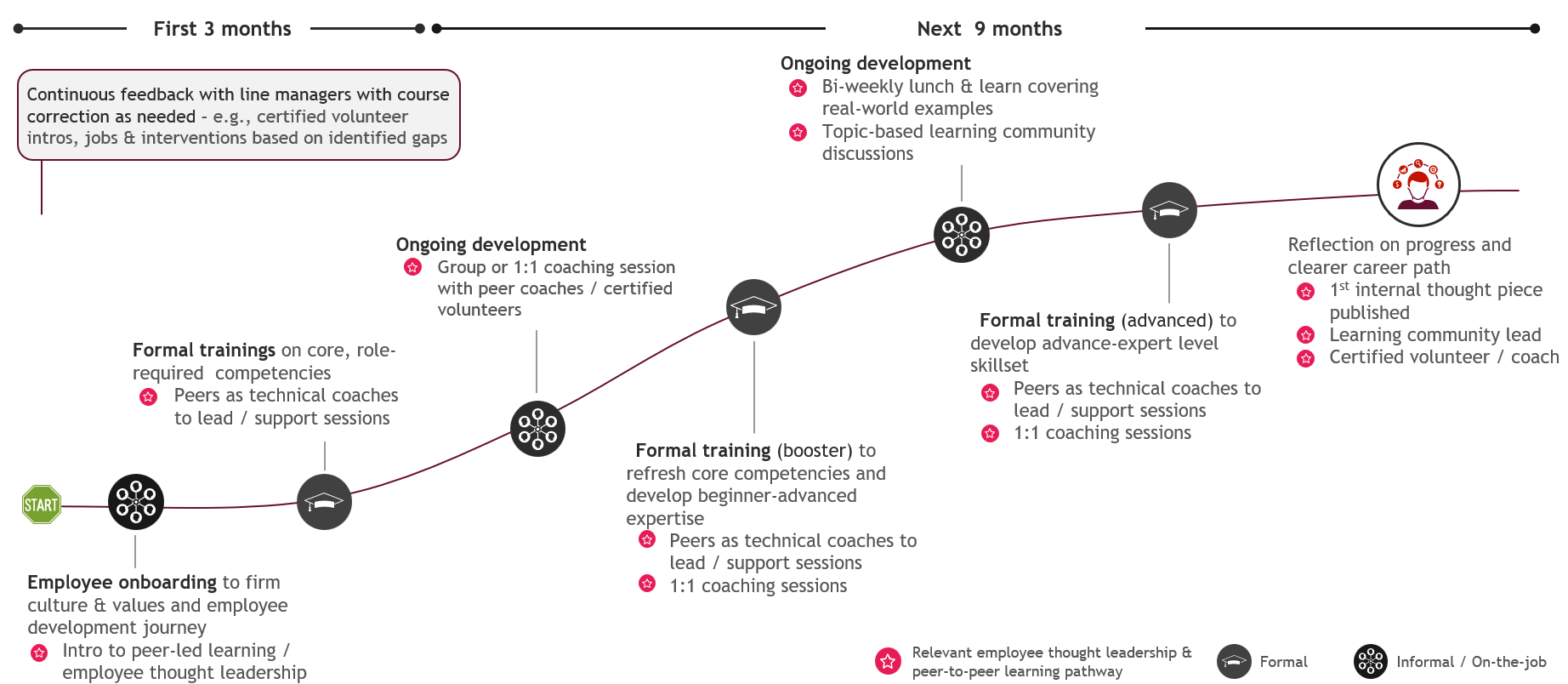
- Align peer-led learning pathways with employee development journeys. The best approach to adopting enterprise thought leadership is to embed it within your current employee development journey with clearly defined expectations for managers and employees. (See exhibit 5 below).
-
Adopt an effective rollout plan in close partnership with L&D stakeholders. An effective adoption of enterprise thought leadership requires the buy-in of all L&D stakeholders including senior leadership and line managers. It also requires an approach that is adaptive to company culture and prioritizes quick wins.
Exhibit 4: E.g., How enterprise thought leadership fits into employee development journeys
The Future is Collaborative
Peer-to-peer learning is no longer a trend – it is a competitive advantage. As skill needs accelerate and employee expectations evolve, organizations that invest in Enterprise Thought Leadership and peer learning will drive better engagement, faster upskilling, and a more resilient workforce.
The future of corporate learning is not just about what employees know. It is about what they share – and how they belong.
Related Service

Authors

Emmanuel Adu-Darko
Managing Partner
Washington, DC

Precious Gyau
Partner & Country Director
Accra

Elizabeth Ewudiwa
Partner, Enterprise Thought Leadership
Accra